
What Is Diethylene Glycol and Why Is It Used?
What Is Diisopropylamine Used For?
Welcome to Servochem LLC. In modern industry, where everything is focused on accuracy, chemical intermediates are playing an important part in the performance of products, manufacturing productivity and survival in business over time. Diisopropylamine-DIPA is an example of such compounds. It is famous for qualities like reactive management, good solubility and chemical stabilization which has made it vital for the different industries.
Knowing the purpose of DIPA is not just in chemistry textbooks. People like procurement managers, formulation scientists and the diisopropylamine manufacturers want the supply to be reliable and for prices to stay stable. Also, application working well is kind of important.
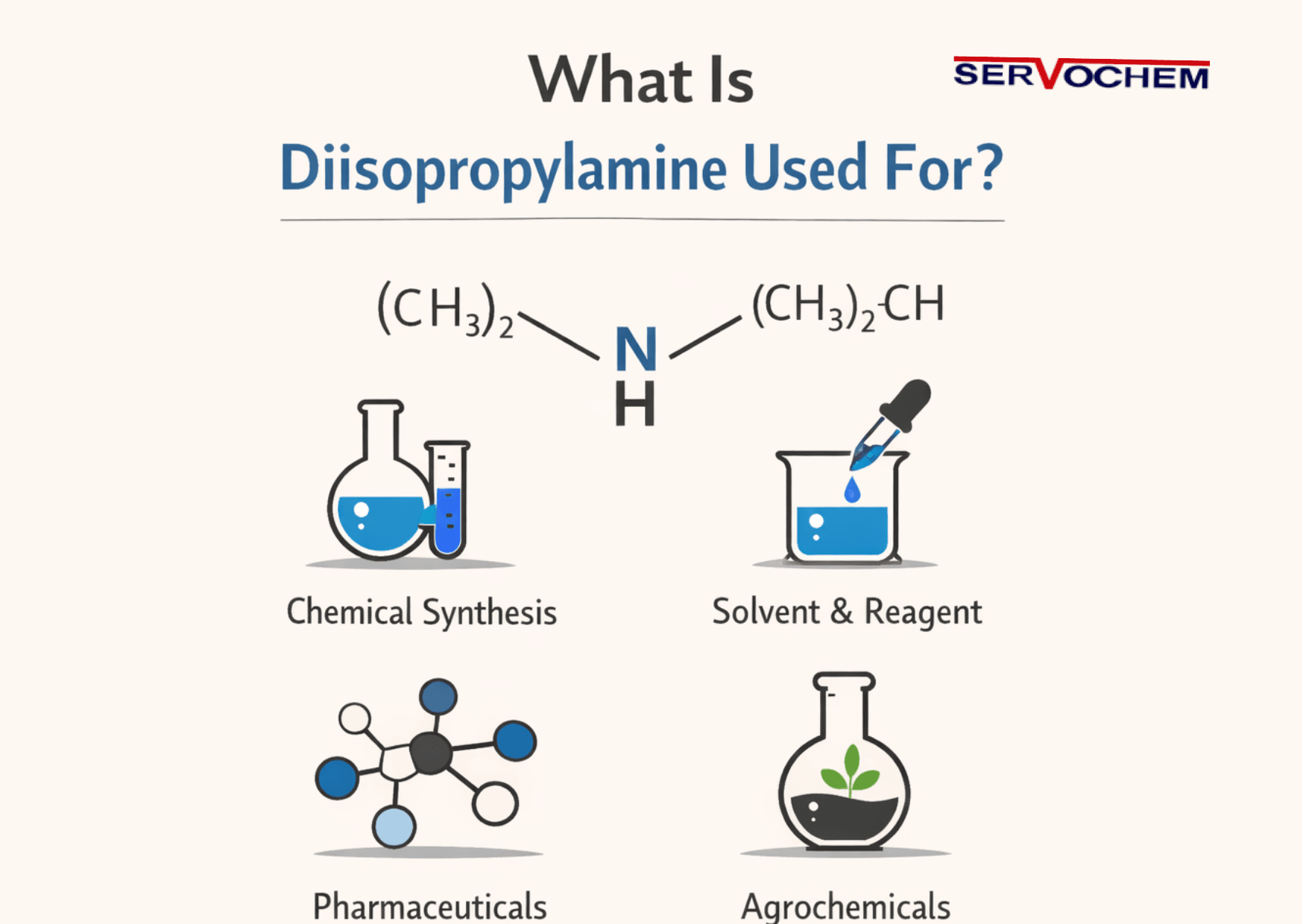
Servochem LLC, which has more than 40+ years work in the field, looks at how diisopropylamine helps modern industries such as pharmaceuticals, polymers, agrochemicals, construction textiles and automobile components.
Understanding Diisopropylamine-DIPA in Industrial Chemistry
DIPA belongs to secondary aliphatic amines and is identified by steric blocking and with a regulated amount of nucleophilicity. Such things help make it quite useful for applications where reaction selection and purity in the final products are both important.
When you talk from a practical chemistry angle, diisopropylamine (DIPA) is not something for direct use but more for a helpful building piece. By using this, companies are able to control reaction pathways at molecular level so that they do not make too many side products which then really changes efficiency of results and reduces the amount of money spent on cleaning products.
Key industrial characteristics include
- Strongly stable chemically if one controls the steps
- Mixes well in various organic liquids
- Reliable in complicated synthesis with many steps
- Able to be used for nonstop factory methods
Because of such qualities, DIPA gets chosen mainly by the B2B purchasers, not just for research labs.
What Is Diisopropylamine Used For in Pharmaceutical Manufacturing
A major commercial reason for What Is Diisopropylamine Used For happens in pharmaceutical processing. DIPA plays an important part as base for reactions, an intermediate stabilizer, and helps with steps when making active pharmaceutical ingredients.
In drug factories where rules are strict, it is necessary to control the reactions. DIPA allows makers to maintain the level of acidity, stopping unwanted reactions, so they can repeat batches to achieve the same result.
Pharmaceutical use cases include
- making API intermediate,
- having controlled environments of pH in synthesis,
- making the salts and neutralizing procedures,
- lessening impurity amount.
To produce pharmaceuticals, the manufacturers that get diisopropylamine from good suppliers get proper regulatory conformity, same quality of batches and running production without stoppages.
The role of DIPA is kind of crucial in ensuring quality and consistency. It, you know, helps in balancing reaction conditions so the final product meets the required standards. Its use also reduces waste, which is important in commercial scale production.
Diisopropylamine Applications in Agrochemical and Crop Protection Formulations
Making agrochemicals wants chemicals that will work well and still keep stable formulas in so many different weathers. Diisopropylamine can do this task because it is used as an intermediate that is reactive in things like pesticides, herbicides or even in the plant safety chemicals. When it comes to a structure, its shape is helping companies to adjust how molecules act so active ingredients can be strong and more precise even if you use less of them.
Why agrochemical producers rely on DIPA
- It gives good base for making special herbicide parts
- Makes shelf life of the chemicals better
- It is good for producing in a bulk
- Yields stay steady in reaction
Especially as agrochemical demand is changing in seasons and volumes, having a steady price for DIPA is really important when buying.
Importance of Diisopropylamine in Polymer, Resin, and Packaging Industries
Amines are getting used many times in polymer fields to affect how curing happens and thickness of cross-linking as well as the molecular structure. DIPA has rather not an obvious but still a very important part when it comes to changing polymers, several special resins and those functional packaging coatings.
Some packaging companies, mostly the ones in tough or industrial packing, are using those polymer products where how reactions behave can decide how long an item lasts.
Uses for industrial polymer include things like epoxy and making new resins, weird plastic agents, putting functional coats on the packaging, and sometimes stopping a polymer chain at a certain length.
When B2B buyers work with packaging or materials, keeping a good supply of diisopropylamine can usually mean less waste in making and slightly improved product properties. I think this is kind of key for many processes.
Use of Diisopropylamine Across Automotive and Construction Supply Chains
Automotive and construction sectors both need materials working under mechanical pressure, many temperature changes and long-term exposure. Diisopropylamine helps a lot, but not directly, in making good coatings, sealants, adhesives or a special mixture of compounds that are utilized in these fields. Its use is hard to see in completed parts, however it changes durability and trustworthiness by a big amount.
Downstream industrial benefits
- Formulations of adhesives are becoming more steady
- Coating finish of the automobile elements made more even
- Helps chemical resistant properties of construction things
- Control for curing reaction increases
Companies who work in expensive sectors usually team up with DIPA suppliers to stop problems with supplies.
Commercial Considerations: Diisopropylamine Price, Supply, and Sourcing
Besides the technical uses, a business should think carefully about buying strategies if they want to know what DIPA is for in business. Prices have a high movement, and things like transport and supplier reputation can influence the manufacturing costs a lot.
diisopropylamine price is typically influenced by:
- How much raw materials exist
- Level of manufacturing and how pure it is
- How much people in region need for medicines and agricultural chemicals
- Worldwide movement and shortages
Smart B2B sourcing practices
- Find sellers that give decent records for quality
- Look for factories with an output that can go higher
- It is better to see overall pricing patterns instead only the current rate
- Get technical support when it is required for your job
Industrial customers can get chemical products from Servochem LLC, that makes solutions for industry with technical skill and also delivers trustable supplies.
Why Diisopropylamine Remains a Strategic Industrial Chemical
DIPA is not known as a regular-use chemical used in a relaxed manner. Its importance lies in accuracy, predictable effects and performance that can be controlled. Many businesses relying on strict rules and careful limits need DIPA so their technical goals and business goals can be accomplished.
In pharmaceutical science areas, plastics making, production of agriculture chemicals and in providers of car materials, diisopropylamine is still used to push development quietly but really important.
As factories around the world make things more specialized, people want trusted chemicals like Diisopropylamine-DIPA more. For those who buy it for their company, knowing how to use it cannot be missed, it is key for the competition.
Diisopropylamine: Frequently Asked Questions (FAQs)
Are MEG and DEG interchangeable in industrial use?
Not always. Although both glycols share similar physical properties, their boiling points, viscosity, and reactivity differ. Substituting one for another without technical validation can affect product performance and process efficiency. Manufacturers must select the correct glycol based on application-specific requirements.
Which industries commonly use MEG and DEG?
Both glycols serve distinct industrial sectors:
MEG: Polyester fiber, PET bottles, coolant and antifreeze, adhesives, and resins.
DEG: Lubricants, polyurethane systems, plasticizers, and solvent formulations.
These applications make MEG and DEG essential for textile, automotive, packaging, and construction industries.
Supplying Diisopropylamine to countries
We Export Diisopropylamine to Saudi Arabia, Iran, Iraq, United Arab Emirates, Qatar, Bahrain, Oman, Kuwait, Turkey, Egypt, Yemen, Syria, Israel, Jordan, Cyprus, Singapore, Malaysia, Indonesia, Thailand, Vietnam, South Korea, Japan, Sri Lanka, Maldives, Bangladesh, Mayanmar, Taiwan, Cambodia, Argentina, Bolivia, Brazil, Chile, Venezuela, Colombia, Ecuador, Guyana, Paraguay, Uruguay, United States of America, Canada, Mexico, Panama, Costa Rica, Puerto Rica, Trinidad And Tobago, Jamaica, Bahamas, Denmark, Russia, Norway, Germany, France, Italy, United Kingdom, Spain, Ukraine, Netherland, Belgium, Greece, Czech Republic, Portugal, Hungary, Albania, Austria, Switzerland, Slovakia, Finland, Ireland, Croatia, Slovenia, Malta, Nigeria, Algeria, Angola, South Africa, Libya, Egypt, Sudan, Equatorial Guinea, The Republic Of Congo, Gabon, Europe, Africa, Asia, North America, South America, Middle East, Far East Etc.
Servochem LLC, is a well known worldwide exporter of Chemical products, is committed to providing each and every customer with the highest standard of customer service. We deal in Diisopropylamine worldwide, offering a wide range of chemical products.
Similar post: Top 3 Diisopropylamine Applications
Internal Links: Diisopropylamine-DIPA
External Links: Diisopropylamine