
What Is Diethylene Glycol and Why Is It Used?
Triethanolamine Chemical Properties
Welcome to Servochem LLC. These days in industrial chemistry, knowing chemical properties is not just a thing for the academics, but it can directly influence things like production efficiency, stable formulas and how businesses do in the long run. Triethanolamine is a compound which has great significance in many industry fields, being a flexible alkanolamine and is usually present in detergents, chemicals for the construction, fluids for metalworking and other manufacturing based on formulas.
When we see global industries, there is need for chemicals that do several things but must stay safe and stable, so Triethanol is becoming even more important. This paper looks at the chemical properties of TEA and tells why they are important for production along with its uses for the buyers of automotive, packaging, textile and construction areas.
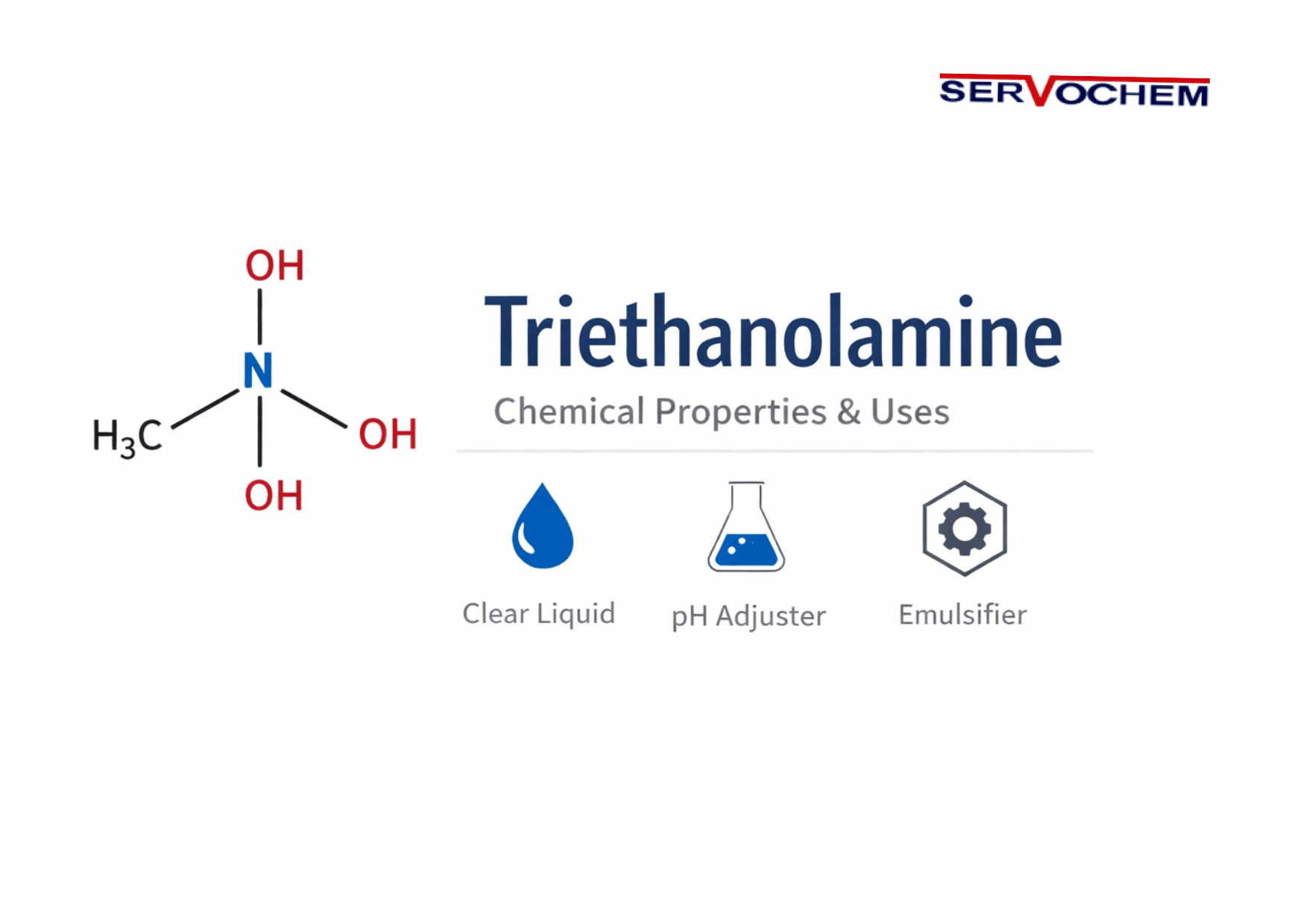
Servochem LLC has over 40+ years experience and is giving the guide to help procurement departments, engineers, the ones who do formulations and people responsible for decisions who are interested in more advanced knowledge about the Triethanolamine on a technical level.
What Is Triethanolamine as a Chemical Compound?
Triethanolamine Chemical is an organic material, placed in alkanolamine group. The production happens by reacting an ethylene oxide with ammonia under control. This reaction forms a substance that shows properties of amine as well as alcohol groups.
In industry areas, Triethanol is useful as it mixes or interacts with acid substances, water solutions and also oily matters at the same time. Because of being so many-purpose, it fits well for different types of work which need chemical steadiness and balancing.
Some main identifiers:
- Name: Triethanolamine
- CAS: Triethanolamine CAS 102-71-6
- Type: Alkanolamine with hydrophilic and alkaline sides
Core Chemical Properties of Triethanolamine
Triethanolamine’s chemical features shape how it acts inside different industries and so it is commonly used in lots of areas in manufacturing.
Physical Characteristics
Usually, Triethanol comes as a pale yellow or sometimes just a clear liquid that is thick. Its smell is kind of like an ammonia and it has hygroscopic qualities where the liquid will pull water from air around it.
In terms of handling, low ease of vaporization and thickness help keep it stable under most typical industrial situations.It is often favored because of these features.
Chemical Behavior in Industrial Systems
Chemical reactions of triethanol are quite important for industrial applications. Due to slight alkaline properties, it can react with acid parts in different mixtures and this means it is usually needed for pH balancing in some systems where this is important.
Its main chemical actions are: neutralizing fatty acid, making emulsions stable, mixing properly in both water and oil as well as not decomposing fast. Because of these features, usage in long runs is reliable.
Why Triethanolamine Chemical Properties Matter for Manufacturers
Formulation Stability and Performance
For makers in the automotive, packaging and textile industries, it is critical to have stable formulations. Triethanol properties are helpful to keep an evenness in things with many kinds of active chemicals. It can control the pH and reacts with surfactants which lowers how likely the products are to separate or break down or not work the same in storage and use conditions.
Sometimes, the stability kind of depends on interactions of triethanolamine with other ingredients and environmental factors.It is important for makers to understand these effects thoroughly to ensure quality.
Compatibility Across Materials
TEA shows a good compatibility for many industrial ingredients such as:
- Surfactants
- Lubricants and oils
- Additives for a cement
- Fluids used in metalworking
- Agents in textile processes
This large compatibility helps producers make the mixtures simpler, but at the same time performance rules still remain followed.
Industrial Applications Driven by Triethanolamine Properties
Use in Detergents and Industrial Cleaners
Triethanolamine gets used a lot in liquid detergents and for making cleaning agents for the industries. The chemical traits it has means it helps surfactant systems through making foam more stable it can also optimize the cleaning power and by regulating pH levels. This advantage becomes very important inside big manufacturing places where maintaining the same quality of products matters a lot.
Like, it is kind of essential in ensuring efficiency in production lines and avoiding problems related with product consistency. The role of triethanol in such environments is quite significant and sometimes overlooked. Overall its contribution increases the effectiveness of detergents greatly and improves performance of cleaning formulations.
Role in Construction and Cement Processing
For building, TEA works as a kind of grinding helper that assists the cement process. Its chemical reaction with parts of the cement allows better milling activities and helps particles to keep spread more equally.
These features allow more energy saving results and let the material do better performance in the larger building jobs.
Function in Metalworking and Automotive Manufacturing
Triethanol has significance because the car and metal industries need it to stop corrosion. It is an alkaline, so it can help by making acidic leftovers from machining become safe which makes less corrosion appear, and keeps equipment working longer.
This way of working from chemicals helps reliability to be high in factories where the making of parts needs precision.
Importance of Triethanolamine in Downstream Industries
Servochem LLC points out three main reasons that the Triethanolamine continues being a very useful chemical in many downstream industries like textile packaging and vehicles supply chain.
- Packaging Industry
- Textile Treatment
- Automotive Production
In the packaging field, chemicals need to stay strong and not break down during production or sitting in storage for a long time. TEA helps formulas not change inside adhesives or in the coatings and for cleaning products that are used in packaging. In textiles, manufacturers require chemicals that work even when the temperature and humid air conditions are changing.
Because Triethanol does not react so easily it is good for washing clothes and processing fabrics. Vehicle production includes chemicals like lubricants, or cleaners also for protecting the surfaces and Triethanolamine improves how stable these items are and helps fight rusting.
B2B Procurement Considerations for Triethanolamine
Bulk Supply and Quality Consistency
When industry buyers want to buy triethanolamine in bulk, they need to focus on how pure it is, how constant quality is, and if the documents are enough. When chemicals differ in the properties it kind of influences the result of the products going ahead.
Some important points in purchasing are:
- Same chemical made every time
- Moisture amount must be checked
- Performance of the batches has to be reliable
- The technical documents should be ready.
Servochem TEA Supply Perspective
Servochem triethanolamine solutions that pay attention to quality assurance, product regularity and business to business trust. Having experience for many years in petrochemical distribution, Servochem is supporting industrial purchasers in a lot of fields.
Here, longer supply stability is mainly important instead of buying for a short period, letting factories have more steady production results.
Triethanolamine: Frequently Asked Questions (FAQs)
What are the key chemical properties of Triethanolamine?
Triethanolamine is a mildly alkaline, water-soluble alkanolamine with both amine and alcohol functional groups. Its key chemical properties include strong acid-neutralizing ability, high compatibility with water- and oil-based systems, low volatility, and stable performance across a wide range of temperatures, making it suitable for industrial formulations and processing applications.
Why do Triethanolamine chemical properties matter for industrial manufacturing?
The chemical properties of Triethanolamine directly influence formulation stability, corrosion control, and process efficiency. Its ability to maintain pH balance, stabilize emulsions, and resist chemical breakdown helps manufacturers reduce formulation failures, improve consistency, and ensure reliable performance in large-scale industrial operations.
Supplying Triethanolaminel to countries
We Export Triethanolamine to Saudi Arabia, Iran, Iraq, United Arab Emirates, Qatar, Bahrain, Oman, Kuwait, Turkey, Egypt, Yemen, Syria, Israel, Jordan, Cyprus, Singapore, Malaysia, Indonesia, Thailand, Vietnam, South Korea, Japan, Sri Lanka, Maldives, Bangladesh, Mayanmar, Taiwan, Cambodia, Argentina, Bolivia, Brazil, Chile, Venezuela, Colombia, Ecuador, Guyana, Paraguay, Uruguay, United States of America, Canada, Mexico, Panama, Costa Rica, Puerto Rica, Trinidad And Tobago, Jamaica, Bahamas, Denmark, Russia, Norway, Germany, France, Italy, United Kingdom, Spain, Ukraine, Netherland, Belgium, Greece, Czech Republic, Portugal, Hungary, Albania, Austria, Switzerland, Slovakia, Finland, Ireland, Croatia, Slovenia, Malta, Nigeria, Algeria, Angola, South Africa, Libya, Egypt, Sudan, Equatorial Guinea, The Republic Of Congo, Gabon, Europe, Africa, Asia, North America, South America, Middle East, Far East Etc.
Servochem LLC, is a well known worldwide exporter of Chemical products, is committed to providing each and every customer with the highest standard of customer service. We deal in Triethanolamine worldwide, offering a wide range of chemical products.
Similar post: Why is Triethanolamine used in Cosmetics Products?
Internal Links: TEA Triethanolamine
External Links: Triethanolamine